
DNA vs. RNA: 3 Structural Differences You Must See in 3D
In biology, we are taught the central dogma: DNA makes RNA, and RNA makes protein. But when we look at flat diagrams in textbooks, both molecules look like simple twisted ladders.
To understand why DNA is stable and eternal (it can be extracted from fossils), while RNA is reactive and fleeting (like in vaccines), we need to go beyond paper. Today we will use the Online Visualizer to dissect these molecules atom by atom.
Pro Tip: How to Compare Molecules in Real-Time
Since our visualizer displays one high-detail molecule at a time, we will use an expert trick to compare them:
- Open ChemModel.com in a browser tab.
- Open a new second tab with the same website.
- Now you are ready to compare!
1. The Sugar: The Secret in the Name
The most important difference lies in the name: Deoxyribonucleic Acid vs. Ribonucleic Acid.
- In Tab 1, search for: “Ribose”.
- In Tab 2, search for: “Deoxyribose”.
Spot the difference: Switch quickly between the two tabs (click one, then the other). You will notice they are identical except for a “blinking” detail on the sugar ring:
- Ribose has a hydroxyl group (-OH, red sphere) on carbon 2.
- Deoxyribose does not (hence “deoxy”, without oxygen).
That tiny extra red oxygen atom in RNA is the reason why it is much more chemically unstable.
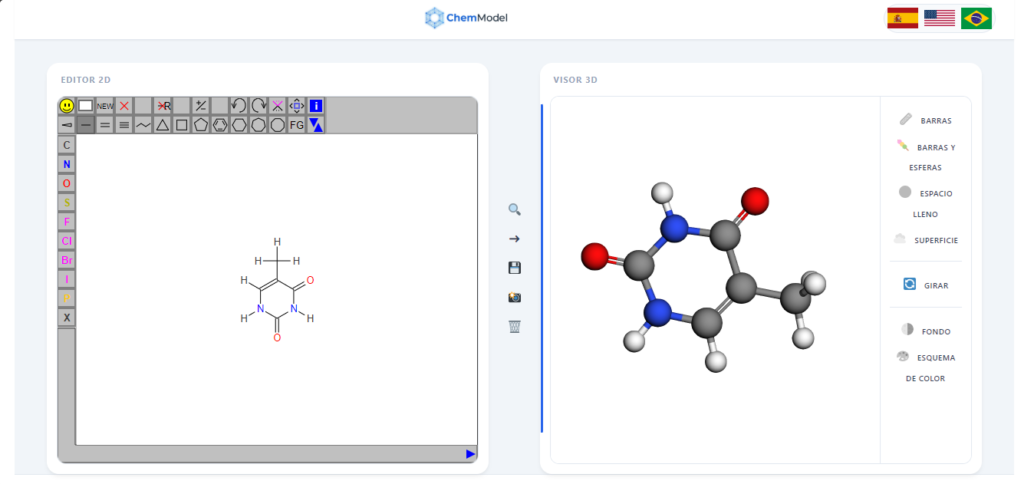
2. The Bases: The Imposter (Thymine vs. Uracil)
We all know that DNA uses A, T, C, G and RNA uses A, U, C, G. But what is the actual difference between Thymine (T) and Uracil (U)?
- In Tab 1, search for: “Thymine”.
- In Tab 2, search for: “Uracil”.
The visual revelation: They are almost the same molecule! The only difference is that Thymine has an extra “hat”: a methyl group (CH3) sticking out the side. When switching tabs, you will see how that group appears and disappears.
This extra group helps protect DNA inside the nucleus. Uracil, lacking it, is energetically “cheaper” for the body to produce, making it ideal for RNA, which is meant for quick use.
3. The Structure: Double Helix vs. Single Strand
DNA forms the famous B-DNA Double Helix because its bases are complementary and rigid. RNA, being generally single-stranded, has the freedom to fold onto itself, forming complex and fascinating structures (like tRNA, which looks like a 3D cloverleaf).
Summary for your Homework:
| Feature | DNA (Visualize it at ChemModel) | RNA (Visualize it at ChemModel) |
| Sugar | Deoxyribose (No O at C2) | Ribose (With O at C2) |
| Unique Base | Thymine (With methyl group) | Uracil (No methyl group) |
| Shape | Rigid Double Helix | Flexible Single Strand |
Enter the lab and see for yourself!